https://laylacassim.co.za/wp-content/uploads/2022/07/UT-banner-01.jpg
https://laylacassim.co.za/wp-content/uploads/2022/07/BANNER-UT-WEB-1280x429-1.jpg

Introduction by Ms Kudsiya Cassim

https://laylacassim.co.za/wp-content/uploads/2022/07/UT-Cover-640x823-1.jpg

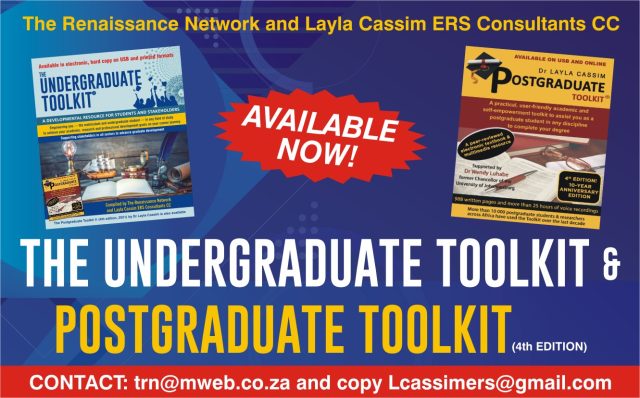
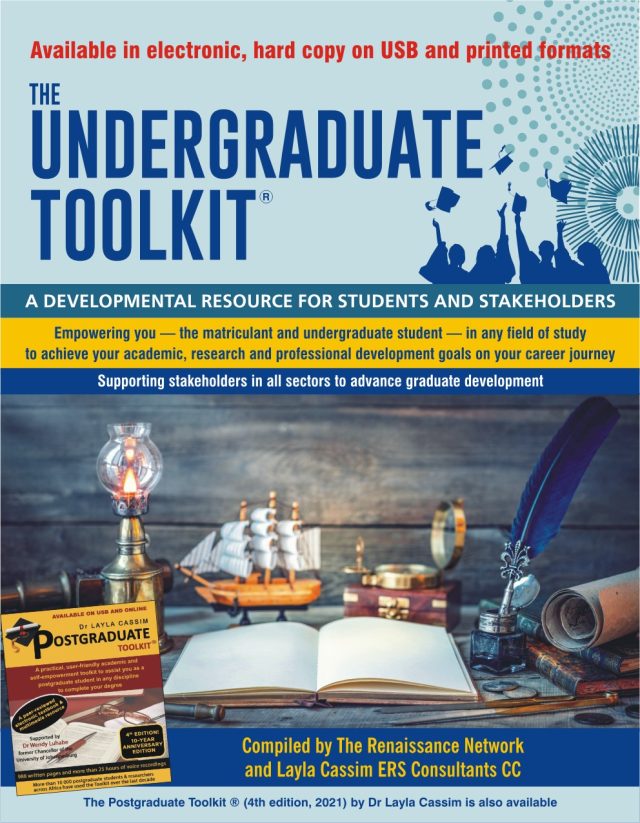
Namaste…. I greet you warmly in the spirit of ubuntu, peace and goodwill. It is such a privilege for the Cassim family to share our humble contributions to advance student development in the higher education landscape, in South Africa, the African continent and anywhere else on the globe where our outreach can be felt.  Our two flagship contributions are both our new Undergraduate Toolkit, launched online on 22 April 2022, as well as the 4th edition of our Postgraduate Toolkit, which has been assisting thousands of students from its inception in 2011.  The online launch of The Undergraduate Toolkit: A Developmental Resource for Students and Stakeholders® can be viewed on The Renaissance Network’s channel on YouTube by accessing the link: https://youtu.be/XRaXA2IjRhU
https://laylacassim.co.za/wp-content/uploads/2022/07/Layla-Bookshop.jpg

I am the founder of our family business, The Renaissance Network, whose areas of specialisation include Human Resource Development, Employee Relations, Labour Law, Research Studies and Workplace Transformation.  We have been in operation from 1999.  My daughter, Dr Layla Cassim of Layla Cassim ERS Consultants CC, is the author of the Postgraduate Toolkit and the co-author of The Undergraduate Toolkit. My son, Rieaz Cassim, is the researcher for The Undergraduate Toolkit; in addition, he has also authored Chapters 2 and 10 and co-authored Chapter 9 of The Undergraduate Toolkit. My motivation to put together a self-empowerment resource such as the Postgraduate Toolkit dates back to the time when Layla commenced her Masters in Pharmacology in 2005 at Rhodes University.  As a parent, I was conscious of especially the often-arduous research-related challenges that students face as they advance to the postgraduate phase of their academic journeys.  I wanted to invest in some kind of “self-help” learning resource that would enable her to transition more easily into this new space.  Unfortunately, there was nothing available in our local book stores except for Dr Erik Hofstee’s book on Constructing a Good Dissertation. Layla was fortunate that she had an excellent supervisor under whose care she successfully completed her PhD at the age of 24.  Being in the skills development field and having been frustrated that I could not source enlightening resources to assist my daughter, I felt compelled to address the need for some form of tried and tested tips for postgraduate success.  This led to my request to Layla to share some of her experiences with those who are in the postgraduate space.  She also identified with this need and compiled the 1st edition of the Postgraduate Toolkit in 2011.  This has been well received by students and academics alike.  Over the years, we received many enquiries for a similar resource for undergraduate students.  This led to the birth of the new Undergraduate Toolkit, which we are very excited about.  We trust that it makes a similar value-adding contribution to the lives of students from their high school years into their university life.

View the Foreword to The Undergraduate Toolkit penned by Mr Khaya Sithole (CA (SA)).

View the profiles of the co-developers of The Undergraduate Toolkit and some Reviews of the Toolkit.

Users and Promoters of The Undergraduate Toolkit

This Undergraduate Toolkit is a resource for the following users and key stakeholders in the senior secondary school and higher education space who are directly or indirectly associated with those embarking on tertiary studies:
  • Grade 11-12 learners, college students and matriculants
  • Undergraduate students across all academic disciplines
  • Various internal stakeholders within institutions of higher learning, which include academics, lecturers, researchers, heads of departments, administrators, student support personnel and student representative councils
  • External stakeholders in the public sector in South Africa associated with undergraduate studies at institutions of higher learning, which include the Department of Higher Education and Training, the Council for Higher Education (CHE), the National Research Foundation (NRF), the Human Sciences Research Council (HSRC), the Medical Research Council (MRC) and the Council for Scientific and Industrial Research (CSIR)
  • Funders from the public and private sectors as well as civil society organisations that provide financial support to undergraduate students in the form of bursaries, scholarships or loans
  • Parents, guardians and/ or family members of secondary school learners and undergraduate students
  • Interested role-players from community-based organisations, faith-based organisations, trade unions, political parties, women’s organisations, professional bodies/ councils, organisations that promote the advancement of students with disabilities and youth upliftment bodies.
https://laylacassim.co.za/wp-content/uploads/2022/07/Photo-credit-@uxindo-on-Unsplash.page-43-scaled-1.jpg

Benefits for students across all disciplines and at any stage of their university life

The Undergraduate Toolkit:

  1. Aims to equip students with academic preparedness skills that can help them to successfully complete their degrees, diplomas or certificate courses
  2. Enlightens students with personal testimonies of young professionals who share their words of wisdom, triumphs and challenges on their academic and career enrichment journeys with a view to share experiences and pass on advice
  3. Seeks to empower students to address key quality of life challenges that can often undermine their academic performance and progress, such as health-related problems, stress, financial difficulties, poor time management and possible disputes
  4. Encourages those students who are working on a full-time or part-time basis with multiple commitments to balance their work/ home/ life more effectively
  5. Introduces students to the fundamental principles of research, and thus could assist them to prepare for future postgraduate studies and research projects
  6. Offers students invaluable tips on improving their reading, writing, adult learning and study skills to advance their scholarly pursuits
  7. Exposes students to the age-old tool of mentorship, through which they can fast-track their academic, personal and professional development under the care and guidance of a supportive mentor and/ or coach
  8. Emphasises the integral role of the library in aiding students to deepen their knowledge of subject matter that they are studying
  9. Presents students with beneficial strategies and action steps to promote self-discovery and self-management for success
  10. Provides students with numerous opportunities to undertake personal reflection and introspection with practical exercises that heighten their self-awareness and self-empowerment whilst challenging them to seek ways to continually improve themselves in key facets of their lives
  11. Affords students an opportunity to benefit from advice, lessons learnt and/ or motivational messages by professionals with extensive experience and expertise in their specific occupations
  12. Highlights key transitional steps for students that will facilitate their smooth entry into the world of work
  13. Draws students’ attention to the importance of familiarising themselves with the specific requirements for membership and/or registration with their respective professional body/ council
  14. Provides guidance on resources students may access if they are or become disabled and that may support them to overcome barriers that prevent their advancement or that of persons with disabilities in general
  15. Is intended to capacitate undergraduate students towards the successful achievement of their academic goals and thereby improve throughput rates at institutions of higher learning

A note to the stakeholder users associated with graduate and postgraduate development from all sectors of society

https://laylacassim.co.za/wp-content/uploads/2022/07/UT-PT-banner-wide-2048x366-1.jpg

In a spirit of collaboration, an appeal is made to institutions of higher learning, organisations in all sectors of society, individuals and parents, to invest in advancing the academic and career development journeys of students under your watch.  Parts B and C of this Toolkit offer key stakeholders in all sectors of society opportunities to make this Undergraduate Toolkit and/ or our Postgraduate Toolkit (4th edition) available to every registered student at both public and private institutions of higher learning.  It is also a useful resource to learners in Grades 11 and 12 and matriculants who are planning to embark on a higher education route.

In addition, we offer a wide range of training and development workshops and specialist services, such as mentorship and coaching, to students, staff and dependants of staff.  Details of the menu of training services are also included in Parts B and C of this Undergraduate Toolkit.  Interested parties are invited to make contact with us to explore the most cost-effective options available to you for students under your care to reap the benefits of these self-empowerment resources.

Click the download links below to view Parts B and C of the Toolkit.
https://laylacassim.co.za/wp-content/uploads/2022/07/UT-Chapters-Collage-1920x1280-1.jpg

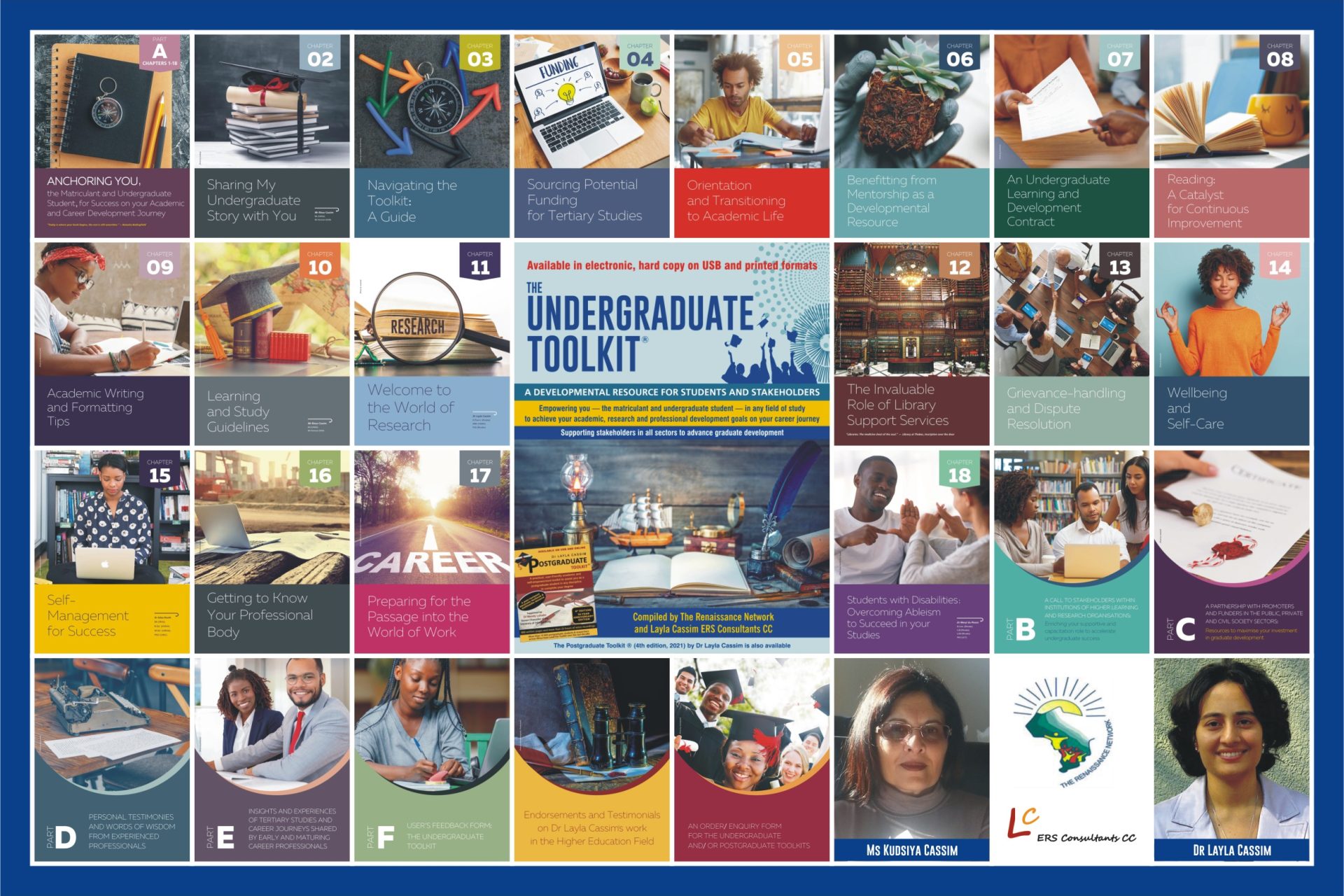
An overview of The Undergraduate Toolkit®

There are six distinct parts aimed at diverse reading audiences that include student beneficiaries, educators and promoters/ funders of such a learning resource. This is a publication of 880 pages. Each chapter contains practical exercises and a self-reflection log.

Click on the links below for the Table of Contents, an overview of each of chapter and its key learning outcomes as well as the various parts of The Undergraduate Toolkit.

Cost of the Undergraduate and Postgraduate Toolkits

How do you obtain a copy of the Postgraduate and/ or Undergraduate Toolkits?

Both Toolkits are available for sale, on USB and also online, where they can be downloaded.  The printed medium of The Undergraduate Toolkit will be available on demand.

If you purchase the Postgraduate Toolkit (4th edition) only (USB or online), the cost is R600 ex VAT (total = R690) (postage included for USB)

If you purchase The Undergraduate Toolkit only (online), the cost is R600 ex VAT (total = R690)

If you purchase The Undergraduate Toolkit only (USB) and you are from within South Africa, the cost is R850 ex VAT (total = R977.50) (postage included)

If you purchase The Undergraduate Toolkit only (USB) and you are from outside South Africa, the cost is R950 ex VAT (total = R1092.50) (postage included)

SPECIAL DISCOUNT FOR COMBINATION ORDER!

If you purchase BOTH the Postgraduate AND Undergraduate Toolkits (online), the discounted combined price is R1000 ex VAT (total = R1150)

If you purchase BOTH the Postgraduate AND Undergraduate Toolkits (USB) and you are from within South Africa, the discounted combined price is R1250 ex VAT (total = R1437.50) (postage included)

If you purchase BOTH the Postgraduate AND Undergraduate Toolkits (USB) and you are from outside South Africa, the discounted combined price is R1350 ex VAT (total = R1552.50) (postage included)

LICENCE OPTIONS

Secondary schools, colleges, universities and organisations can purchase a licence to have either or both of the Toolkits on their intranets/ online learning platforms, where they will be available to all staff and students for a certain number of years.  Kindly contact us on TRN@mweb.co.za and Lcassimers@gmail.com to find out more about our customised licencing options.

We look forward to hearing from you and wish you all the best in your graduate and postgraduate development initiatives!