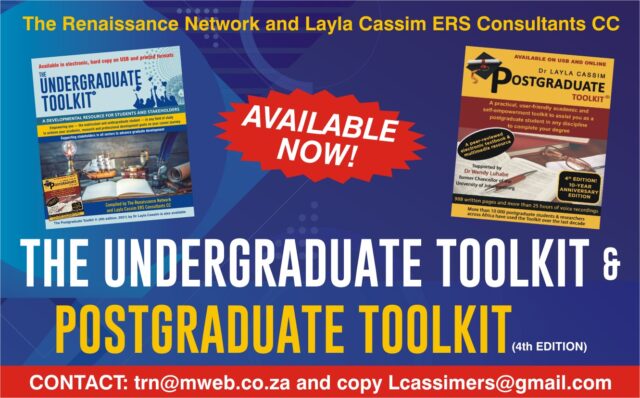
Postgraduate Toolkit

The 4th edition of our Postgraduate Toolkit was launched on 1 January 2021!

2021 marked the 10-year anniversary of our Postgraduate Toolkit and I thought that a good way to celebrate this milestone was to come out with a new edition. Over the last decade, more than 12 000 postgraduate students and researchers across Africa have used the Postgraduate Toolkit. The Toolkit is a peer-reviewed electronic textbook and multimedia resource that assists postgraduate students and emerging researchers across all disciplines and levels of study to complete their research projects successfully and build a long-term research career. The 4th edition is available online (where it can be downloaded) as well as on USB.

What is different about the 4th edition?

  • It contains almost 300 brand new written pages of content across the 10 chapters, bringing the total to 988 written pages
  • 25 hours of voice recordings
  • The voice recordings are both in narrated PowerPoint format, as well as in mp4 format – this was a popular request from students. So you can download and play the voice recordings from your smartphones ‘on the go’
  • 48 practical exercises, 10 reflection exercises and a number of assessment questions and memoranda, to allow you to apply what you have learnt to your research project
  • Extensive updates to the content – especially regarding research design and methodology and academic writing and reading skills
  • The effects of COVID-19 on research and the mental health of researchers has also been covered in detail
  • self-defence video – this reflects our ongoing commitment to promoting women’s empowerment, in particular

The Postgraduate Toolkit emphasises:

  • Indigenous Knowledge Systems and a decolonised view to research
  • Practical research, at a community level, to address socio-economic and other inequalities
  • Interdisciplinarity
  • Intersectionality and a queer-friendly, feminist approach to research
  • Wellness, health and quality of life for postgraduate students and researchers
https://laylacassim.co.za/wp-content/uploads/2022/06/Black-woman-scholar-01.jpg

The 10 chapters of the Toolkit cover the following important topics:

Chapter 1:
Introduction to research & How to write a research proposal

At the end of this chapter, you will be able to do the following:

  1. Understand the historical, philosophical, international and national contexts in which we do research;
  2. Appreciate the significance of ethical considerations in guiding the research process;
  3. Recognise the importance of critical reflective and self-reflexive thinking in research;
  4. Narrow down the scope of your research project and justify how you have done so;
  5. Understand the importance of a well-conceptualised research proposal in guiding the successful execution of the research project;
  6. Understand how the golden thread links the key components of the research project;
  7. Develop a clear research question that will drive the whole project and from which all the other components of the proposal flow;
  8. Develop a Gantt chart to holistically cover all the key activities involved in the research project;
  9. Conduct an in-depth risk analysis to identify risk factors that could undermine the successful execution of the project, as well as develop contingency plans to address these; and
  10. Write a comprehensive, detailed research proposal that meets your university’s requirements.
Chapter 2:
How to write a grant application or funding proposal

At the end of this chapter, you will be able to do the following:

  1. Identify a wide range of possible funders for your research project;
  2. Understand the importance of there being alignment between your project and the strategic priorities of the funder;
  3. Understand key requirements that funders and review panels would have when evaluating funding applications;
  4. Appreciate the significance of eligibility criteria when applying for funding;
  5. Recognise the potential weaknesses and subjectivity in review processes;
  6. Appreciate the importance of a good contract with the funder that protects your rights and independence as a researcher;
  7. Identify the similarities and differences between an academic research proposal and a funding application;
  8. Complete a comprehensive Thuthuka application form to apply for National Research Foundation funding;
  9. Complete a detailed, realistic budget that considers the hidden costs of the research project and in which each line item is justified; and
  10. Complete a detailed project management plan that can be included as an appendix to your funding application.
Chapter 3:
An overview of research design and methodology

At the end of this chapter, you will be able to do the following:

  1. Define what research design and methodology is, and why careful planning is such a key component of this;
  2. Appreciate the importance of effective record keeping;
  3. Identify different types of data (primary and secondary; quantitative and qualitative), the advantages and disadvantages of each and explain why you have chosen a particular type of data;
  4. Understand 18 commonly-used research methods, as well as their sub-types, across a range of disciplines and how to choose the most appropriate method(s) for your research;
  5. Explain key concepts that examiners and reviewers are likely to raise, namely sampling error, sampling bias, non-sampling error, reliability, validity and trustworthiness, and what measures you are taking to address each of these;
  6. Justify your choice of sample size(s) and sampling technique(s);
  7. Conduct a pilot test correctly;
  8. Justify your choice of data analysis methods;
  9. Have a basic understanding of some key principles in descriptive and inferential statistical analysis;
  10. Perform content analysis on qualitative data; and
  11. Write up a well-structured and soundly conceptualised research design and methodology chapter.
Chapter 4:
Guidelines on how to write a thesis and research report

At the end of this chapter, you will be able to do the following:

  1. Have a good writing and editing strategy or routine in place that allows you to complete your thesis in a reasonable amount of time;
  2. Choose the most appropriate thesis structure for your kind of research;
  3. Write each of the chapters or sections within the thesis in a detailed way that shows the logical unfolding of your research question and the golden thread;
  4. Write a high quality literature review that shows an in-depth, critical engagement with the views of various experts and scholars;
  5. Understand what a theoretical framework is, where it goes in the thesis, the importance of being able to justify why you have chosen a particular theoretical framework and how to adapt or combine theoretical frameworks to suit your context;
  6. Identify the difference between a full thesis and a mini thesis or research report;
  7. Comply with your university’s requirements of your thesis as well as requirements for the thesis submission process;
  8. Understand what examiners will be looking for when marking your thesis and what the thesis examination process entails;
  9. Avoid common mistakes in academic writing;
  10. Improve your basic reading and comprehension skills;
  11. Know the difference between thesis writing, scientific writing and popular writing for the media; and
  12. Understand the structure and writing style used for the legal thesis.
Chapter 5:
How to write and publish an academic paper

At the end of this chapter, you will be able to do the following:

  1. Understand the various reasons for why it is important to publish a paper;
  2. Be aware of the significance of publishing books in your career;
  3. Decide on the scope of your paper;
  4. Be able to select an appropriate journal for the paper you are writing;
  5. Be aware of different kinds of papers, such as review articles, protocol papers and original research papers;
  6. Be able to write an original research paper;
  7. Have a structured approach to writing a systematic review article;
  8. Submit a paper to a journal;
  9. Address reviewers’ feedback and be aware of what happens in the peer-review process; and
  10. Appreciate the importance of ethical considerations in research.
Chapter 6:
Tips for oral and poster presentations of your research

At the end of this chapter, you will be able to do the following:

  1. Know when you will be presenting your research;
  2. Understand the importance of communicating your research to a wider audience;
  3. Identify the conferences you would like to attend for the duration of your research project;
  4. Appreciate the role of adequate planning when preparing your oral or poster presentation;
  5. Be able to present your work on an online platform at a webinar, online conference or thesis defence;
  6. Deliver a short oral presentation on your research;
  7. Design a poster that succinctly summarises your project; and
  8. Know the kinds of questions that audience members are likely to ask you about your research and be able to respond to these.
Chapter 7:
Key project management principles in research

At the end of this chapter, you will be able to do the following:

  1. Identify the key characteristics of all research projects;
  2. List the stakeholders that you need in order for your research project to be completed successfully, and manage these relationships;
  3. Appreciate the important role played by the Library at your university;
  4. Set the boundaries of your research project;
  5. Plan carefully for the research project;
  6. Appreciate the significance of understanding the context in which you are doing the research;
  7. Know how to complete your research project within your timeframes and budget and to the required quality specifications; and
  8. Complete a detailed project management plan that will guide you throughout your research project.
Chapter 8:
Some self-empowerment tools and support systems for postgraduate success

At the end of this chapter, you will be able to do the following:

  1. Identify quality of life challenges that may undermine your progress in completing your research project;
  2. Develop a writing schedule, with targets, to work consistently on your thesis;
  3. Have sound time management strategies in place to use your limited time more efficiently and effectively and for you to balance your different commitments;
  4. Seek psychological help if you need to in order to address a personal problem;
  5. Appreciate the importance of self-care on a daily basis;
  6. Activate the right side of your brain and do something creative every day;
  7. Improve your interpersonal communication by using the Johari Window;
  8. Identify ‘blind spots’ that you may have as a researcher;
  9. Determine whether there are factors that undermine your motivation to continue with your research project and how to address these; and
  10. Recommend strategies to your Human Resources Department on what your organisation can do to better support employees who are studying.
Chapter 9:
The student, supervisor and university – enhancing postgraduate supervision

At the end of this chapter, you will be able to do the following:

  1. Know how to choose an appropriate supervisor;
  2. Define mentorship and why it is important for supervisors to be good mentors;
  3. Differentiate between mentorship and coaching;
  4. Be able to assess your dominant mentoring or learning style;
  5. Understand the concept of the emotional bank account;
  6. Know the key roles and responsibilities of the supervisor and student;
  7. Identify your frames of reference and core values;
  8. Manage potential conflict between you and your supervisor;
  9. Complete a mentoring pledge with your supervisor;
  10. Complete a progress report after each progress meeting with your supervisor; and
  11. Identify the different components of a performance management system in academia and how each of these would need to be adapted to ensure better postgraduate supervision.
Chapter 10:
Your Personal and Professional Development Contract (PDC) & Self-employment for researchers

At the end of this chapter, you will be able to do the following:

  1. Identify your short-, medium- and long-term research goals and break down each of these goals into practical activities;
  2. Share the above research goals with your supervisor, receive feedback on these and use these research goals and activities as a yardstick against which to assess your performance;
  3. Determine goals in other aspects of your life, both personally and professionally;
  4. Complete the Personal and Professional Development Contract (PDC);
  5. Use the PDC as a career-development and self-empowerment tool;
  6. Take ownership of achieving your personal and professional goals;
  7. Appreciate the importance of self-employment as a career option in today’s world;
  8. Know how to start your own business;
  9. Understand key success factors that can contribute to the long-term success and sustainability of your business; and
  10. Identify strategies that small businesses can use to survive in the context of the COVID-19 pandemic and lockdown.

Benefits of the Postgraduate Toolkit (4th edition) to users across disciplines, from Honour's to postdoctoral levels

  1. The Postgraduate Toolkit assists postgraduate students at any level of study to write a well-conceptualised research proposal, which is a roadmap to the successful execution of the research project and thesis;
  2. It empowers researchers to be able to identify potential funders and complete a comprehensive funding application for their research projects;
  3. It covers essential concepts in research design and methodology, including 18 different research methods and their sub-types, as well as key considerations that examiners and reviewers will ask about when evaluating a researcher’s research design and methodology;
  4. It empowers postgraduate students to be able to complete a high-quality thesis that meets the university’s criteria for submission and that satisfies supervisors and examiners;
  5. The Postgraduate Toolkit enhances the skills of researchers to publish papers in peer-reviewed academic journals, which is important in building long-term academic and research careers;
  6. The Postgraduate Toolkit emphasises wellness and a holistic approach to research, providing strategies on how to balance research commitments with other key responsibilities and effectively navigate quality of life challenges that may undermine the completion of the research project;
  7. It guides both postgraduate students and supervisors on how to manage and optimise the supervisory relationship, including how to deal with conflict;
  8. It assists anyone interested in research, in any setting or organisational context, to complete a well-conceptualised research project;
  9. It empowers early career academics to build a long-term research career;
  10. It capacitates supervisors of postgraduate students to enrich their mentoring role;
  11. It is also a resource for managers, human resource practitioners, skills development specialists, workplaces and trade unions who wish to actively support employees who are studying;
  12. It provides recommendations to universities, research organisations and regulatory bodies on aspects of performance management systems that need to be transformed in order to significantly enhance postgraduate supervision; and
  13. It promotes the use of indigenous knowledge and a queer-friendly, intersectional feminist and decolonial approach to research in order to address pressing socio-economic and other inequalities in South Africa, on the African continent and more globally.
“The COVID-19 pandemic has forced us to re-evaluate how we work, and has prompted the switch to online teaching, learning and research at our institutions of higher learning. I commend you for making the Toolkit available as an electronic and online resource. I am convinced it will play an important role in assisting students to complete their research projects successfully in this challenging context and, possibly, encourage a much higher number of students to consider postgraduate research”
Dr Wendy Luhabe, Social entrepreneur
“Reading through the various aspects of your Toolkit, I am truly astounded at your meticulous delivery of its content. Wow! I am lost for words. You have thoroughly and systematically outlined the entire research process in such a user friendly, interactive and comprehensive way. Compiling such a Toolkit for postgraduate students across all disciplines cannot be an easy task, I am sure. Yet I found your Toolkit simple to navigate and the topics you cover more than relevant. I have no doubt that the users of your Toolkit could also attest to this. In fact, I used your Chapter 5 on “How to write and publish an academic paper” as a guide as I wrote up my Master’s research. This was hugely helpful and I actually received news this week that my research will be published in October in the Journal of Psychology in Africa”
Phillipa Haine, PhD student
“You really helped me understand concepts of research I was struggling with for years. The way you explained them has motivated me to study further”
Nomaza, Master’s student
“Dr Layla Cassim is the best facilitator that I have ever met. Her toolkit is designed in a way that makes it so easy for students to understand”
Rolex Aluoch, Master’s student
“Dr Layla is an exceptional teacher; her teaching skills are excellent. The content of her tool kit is above everything. Her training methodology allows you to learn on your own and yet provides you with all necessary tools. I was so impressed by the content of her voice recordings. I wish many books and other study materials could be in an audio format as I learn so much better listening than reading. She has met and exceeded my expectation. I am so motivated to further my studies and I will be making sure I work closely with Dr Layla. I already have a good feeling about the journey I am about to embark on; I feel confident enough to enrol with any university of my choice because I now know where to begin. Thank you so much for bringing so much positivity in my life and career. Please continue planting the seeds and shine brighter”
Omphile Khutsoane
“Absolutely amazing and mind blowing. I went into the course a bit skeptical as I wasn’t sure how different this would be from what universities give you but it’s very different. She teaches you to be an open thinker as well as to be the best researcher you can be. The course motivated me to do the best I can for my Master’s”
Aaliyah Motala, Master’s student
“A quick note from my side to say thanks once again for the amazing workshop that I attended in May 2019. I managed to pass my mini-dissertation (MCom Industrial Psychology) at the University of Pretoria with 81% and also submitted it 4 months before the due date. I incorporated all the concepts that were covered during your workshop for the proposal stage in 2019 and also for the submission of the mini-dissertation in 2020″
Sherwyn Roussouw
Anyone who has attended one of my research workshops, purchased a previous edition or who has received a complimentary copy from me in the past can upgrade to the 4th edition FOR FREE! (You just need to please email me (Lcassimers@gmail.com) the date of the workshop and at which institution it was held, the invoice number or the date on which I gave you a complimentary copy, so that I can check my records. I will then email you the link where you can download the 4th edition)

Buy a copy of the Postgraduate Toolkit (4th edition)

The Toolkit is available for sale. The price is R600 ex VAT (total is R690). Please click below to purchase it – you will need to indicate whether you would like online access or the USB.

Institutional licence for the Postgraduate Toolkit (4th edition)

Universities and research organisations can purchase a licence to have the Postgraduate Toolkit on their website/ online learning platform, for their staff and students, for a certain number of years. The University of Limpopo has done this, and the Postgraduate Toolkit is available on the UL system for all staff and students. Please contact me on Lcassimers@gmail.com to find out more about this option.

SPECIAL DISCOUNT FOR COMBINATION ORDER!

If you wish to purchase BOTH our Postgraduate and Undergraduate Toolkits, there is a special discount.  

If you purchase BOTH the Postgraduate AND Undergraduate Toolkits (online), the discounted combined price is R1000 ex VAT (total = R1150)

If you purchase BOTH the Postgraduate AND Undergraduate Toolkits (USB) and you are from within South Africa, the discounted combined price is R1250 ex VAT (total = R1437.50) (postage included)

If you purchase BOTH the Postgraduate AND Undergraduate Toolkits (USB) and you are from outside South Africa, the discounted combined price is R1350 ex VAT (total = R1552.50) (postage included)

Institutional licence – universities, research bodies and/ or organisations in any sector of society that would like to get a licence to have both Postgraduate and Undergraduate Toolkits on their website/ online learning platform will get a discounted rate.  Please contact me on Lcassimers@gmail.com to find out more about this.