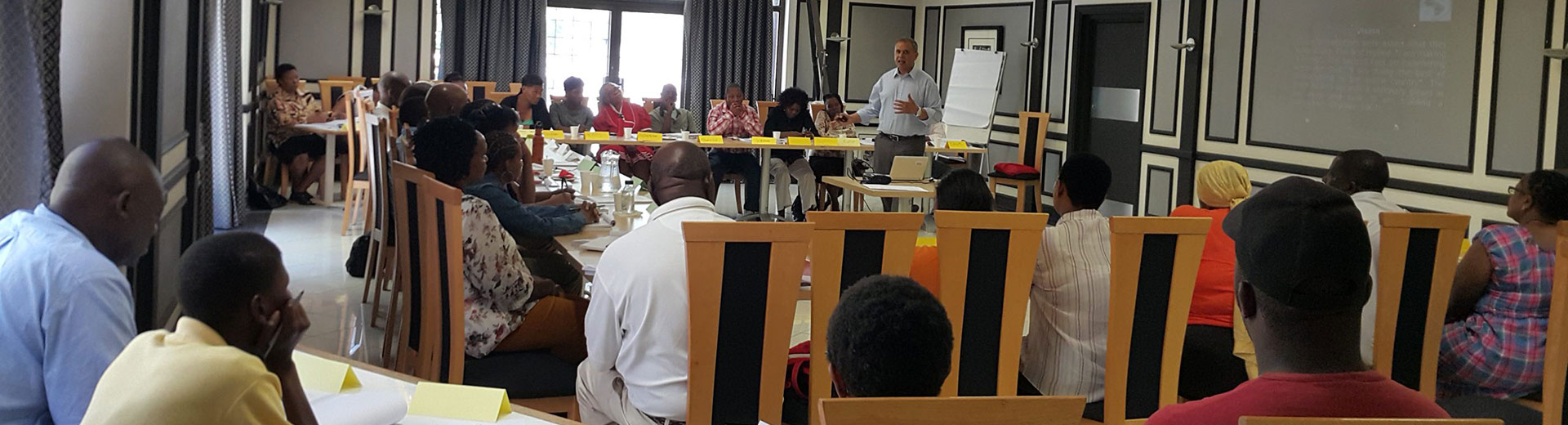
Human resources and labour law services

In my business, I work closely with two associates – The Renaissance Network (which is my parents’ business) and RedChord (Pty) Ltd (which is my partner Dr Meryl du Plessis’s business).

The Renaissance Network is a Black, female-owned South African Human Resources and Labour Law consultancy with a staff complement of highly qualified professionals and a well-capacitated team of Black and female business associates who are also in the SMME sector offering outstanding professional services in their areas of expertise and specialisation.  We have a proud track record primarily in the field of Research and diagnostic services; Postgraduate capacitation and development; Organisational climate and culture audits; Policy/ strategy review; Management and HR consulting; Skills development and capacitation; Mentorship and coaching, Labour law and labour relations; Workplace transformation; as well as Organisation development, capacitation, development and auditing in South Africa.  The Renaissance Network is a fully accredited Training Service Provider with the Services SETA. 

Ms Kudsiya Cassim is the Founder and Managing member of The Renaissance Network. She holds a BA degree, the Advanced Executive Programme and numerous business-related qualifications.  She has an extensive experience and expertise profile of 38 years in the field of Human Resource management and Management consulting, which includes specialist competencies in areas such as Governance and Business ethics; Workplace transformation; Organisational culture and climate audits; Skills audits; Research studies; Performance management; Human resource management; Organisational policy and Strategy design, review, implementation, monitoring and evaluation.  Long-standing clients include Parliament of the Republic of South Africa, the Presidency of the Republic of South Africa, the City of Johannesburg, MTN-SA and the City of Ekurhuleni.

The Renaissance Network commissioned Dr Layla Cassim to compile the first edition of the Postgraduate Toolkit in 2011.  Kudsiya believed that this humble initiative would serve as a value-adding contribution to postgraduate success in the higher education and research landscape in South Africa and the African continent.  The Undergraduate Toolkit was subsequently developed and launched by The Renaissance Network and Layla Cassim ERS Consultants CC in 2022.

Adv. Hassan Cassim holds BA and LLB degrees from UNISA and an LLM (Human Rights Law) from the University of Johannesburg.  Adv. Cassim is a seasoned Senior Management and Labour Law consultant providing a specialist service to clients in both the public and private sectors on the full spectrum of Business strategy and processes, Research and diagnostic studies, Labour law and labour relations, Organisational development and Governance in the transforming workplace.  One of his consulting assignments was the drafting of South Africa’s National Anti-Corruption Strategy (NACS), over the period 2018-2020 for the Department of Planning, Monitoring and Evaluation, housed in the Presidency. 

His expertise includes the design and facilitation of workplace learning programmes in HR and Labour relations; Governance and ethics; Organisational policy and strategy development, implementation and monitoring and evaluation; Dispute resolution, mediation, representation at the CCMA and the Labour Court; Organisational culture and climate audits; and consulting and training on comprehensive services related to the implementation of Employment Equity and Labour law in compliance with legislation and in keeping with best practices.  He has extensive Project management experience with verifiable large-scale projects successfully implemented in primarily public-sector organisations in South Africa.  He has authored a number of reports with clearly-defined implementation plans and progress monitoring and evaluation measures for a range of clients.  He has a strong understanding of public service legislation, constitutional and regulatory processes and strategic goals of the RSA National Development Plan.  He has critically reviewed and reported on a range of organisational policies with the aim of ensuring legal compliance in terms of current legislation and governance imperatives.  

Mr Rieaz Cassim holds a BA (majors in Geography and History) from UNISA and a BA Honours in History from the University of Stellenbosch.  He is a senior administrator and researcher in The Renaissance Network.  His functions as an administrator mainly include data capturing and report writing on various management consulting and training-related services offered by the business to a range of clients, whilst his role as a researcher involves specialist projects such as the development of The Undergraduate Toolkit for learners in the higher education sector.

RedChord (Pty) Ptd

Dr Meryl du Plessis holds BCom, LLB (with distinction) and LLM (with distinction) degrees from Rhodes University and a PhD (Commercial Law) from the University of Cape Town.  RedChord (Pty) Ltd provides advisory services in the areas of labour and social security law.  Meryl has advised employers and employees on aspects such as occupational health and safety, the rights of employees with disabilities and managing disability in work contexts, the rights of pregnant employees, and various forms of harassment at work. She is a member of the South African Law Reform Commission’s Advisory Committee on Project 143, which deals with maternity and parental benefits for informal workers.   

She aims to help create, maintain and/ or support endeavours by various role players (such as workers, employers, government and communities) to improve people’s work experiences and workers’ social security, with a particular focus on workers’ and employers’ rights and duties in terms of national and international laws, policies, standards and guidelines.  Where appropriate, RedChord (Pty) Ltd collaborates with associates in human resource management, occupational health and safety, labour relations practice, industrial psychologists and/ or occupational therapists to provide more holistic and comprehensive research, perspectives and advice.  RedChord (Pty) Ltd is also committed to the development of research capacity, particularly in the areas of law in general, or labour and social security law more specifically.  Meryl therefore engages in research development initiatives by mentoring and supporting early-career researchers in those fields, whether through working with research institutions or in the form of individual support to such researchers.

Training calendar, dates and delegate fee (VAT inclusive unless otherwise stated).  Please click on the name of a workshop for the key focus areas/ learning outcomes of that workshop. All these workshops can be conducted in-house in organisations on a national and continental basis.  Workshops are conducted online.

For more information on the profiles of our businesses and facilitators, and cost-effective rates for in-house workshops, kindly contact Ms Kudsiya Cassim on +2783 786 8605 or email her at trn@mweb.co.za and copy TRN.RENNET@gmail.com

Workshop 1:
Implementation of Employment Equity in the Workplace

Date(s): TBA
Cost per delegate: R 5 750.00

Key focus areas include the following:

  • Understanding the legal requirements of the Employment Equity Act and its related amendments
  • The 2022 Amendment Act
  • Understanding sectoral targets
  • Compiling relevant Employment Equity (EE) and organisational transformation reports and trend analyses
  • Submission of legally compliant EE Reports
  • Designing monitoring processes to ensure effective implementation of EE
  • Preparing and implementing a comprehensive report and recommendations on the overall status of EE implementation within a company
  • EE Forms and Regulations
  • Understanding workplace discrimination
  • Duties of a designated employer
  • The role and responsibilities of an Employment Equity Forum/ Committee:
    • Capacitation for forum members
    • Skills and knowledge audit/ assessment
    • Organisational support systems
    • Accountability to constituencies
    • Custodian of organisational transformation
Workshop 2:
Addressing Harassment in the Workplace: Learning areas inclusive of Bullying & Sexual Harassment

Date(s): TBA
Cost per delegate: R 3 450.00

Key focus areas include the following:

  • Understanding the applicable legislative framework in respect of harassment, including the Employment Equity Act, the Promotion of Equality and the Prevention of Unfair Discrimination Act and the Protection from Harassment Act
  • Understanding and applying the 2022 Code of Good Practice on the Prevention and Elimination of Harassment in the Workplace
  • Understanding the definition of harassment and the different forms of harassment in the workplace
  • The rights of employees
  • Roles and responsibilities of the employer
  • The rights of survivors of harassment
  • Understanding the application process for a protection order
  • Understanding, addressing and preventing workplace bullying
  • Types and manifestations of bullying in the work context
  • Handling of workplace bullying concerns and complaints
  • Contextualising sexual harassment within contemporary South African employment environments
  • Definitions and manifestations of sexual harassment
  • The employer’s obligations to employees
  • Sexual harassment policies and procedures at organisational level
  • Promotion and implementation of policies and the building of institutional cultures that address and eliminating sexual harassment
  • Handling of sexual harassment complaints within organisations
Workshop 3:
A Workshop for Mentees: Mentee Development for Career Enrichment & Advancement (in the workplace setting in all sectors of society)

Date(s): TBA
Cost per delegate: R 3 450.00

Key focus areas include the following:

  • Sourcing a suitable mentor
  • Setting up your mentoring partnership for success
  • Key roles, responsibilities and positive behavioural attributes of a mentor and a mentee
  • Appreciating the benefits of mentoring
  • Exploring different types of mentoring relationships
  • Key elements of an Undergraduate Learning and Development Contract
  • Planning for your first meeting with your mentor
  • Adaptable templates for practical use on your mentoring programme
  • Useful self-reflective and introspective exercises for your personal growth and development
Workshop 4:
A Workshop for Mentors: Mastering your Mentoring & Coaching Skills (in academic, workplace or any type of mentoring context)

Date(s): TBA
Cost per delegate: R 3 450.00

Key focus areas include the following:

  • Mentors will acquire the necessary knowledge and understanding of their role, responsibilities and positive behaviours to effectively engage in a structured mentoring relationship with mentees
  • Mentors are able to identify the diverse needs of adult learners as they relate to the philosophy of lifelong learning, growth and development
  • Mentors are able to conduct coaching and counselling sessions with mentees using clearly defined guidelines for both interactions
  • Mentors can influence and guide identified learners to design a holistic and well-balanced personal development contract, which will play a pivotal role in laying the foundation of a formalised mentoring relationship
  • Mentors are able to integrate the role of mentorship within the Human Resources Development Strategy of the organisation and the relevant national legislative framework
  • Mentors can differentiate between the primary roles, responsibilities and positive behaviours of key internal stakeholders involved with the mentorship process in the organisation
  • Mentors are enabled to effectively prepare for their mentoring engagements
Workshop 5:
Work and Persons with Disabilities

Date(s): TBA
Cost per delegate: R 5 750.00

Key focus areas include the following:

  • The functions of work
  • Workplaces as sites of exclusion, as well as people’s access to some forms of social security
  • Reflections on why so many persons with disabilities are excluded from employment in spite of affirmative laws – “whose problem is it anyway”?
  • Discourses on disability, persons with disabilities and work
    1. Legal conceptions of disabilities and implications for persons with disabilities’ access to work
    2. Analysing debility, capacity and disability, and the relationship between these
    3. Critiquing our conceptions of disability
    4. Critiquing the notion of inclusivity
  • Accessibility and reasonable accommodation
    1. Addressing unfair discrimination in the workplace and why that, on its own, is not enough for many persons with disabilities to access and maintain employment
    2. What is accessibility?
    3. The links between other sites of inaccessibility and inaccessible workplaces
    4. Creating accessible workplaces
    5. What is reasonable accommodation?
    6. What are the differences and the interrelationships between accessibility and reasonable accommodation?
    7. Key aspects of reasonable accommodation
    8. Funding reasonable accommodation
  • Persons with disabilities and access to decent work
    1. What is ‘decent work’?
    2. Learnerships and their role in facilitating employment for persons with disabilities
    3. Ways to address exclusion – from outside to inside workplaces
    4. Recruitment and selection
    5. Training and development
    6. The creation of affirming work cultures
    7. Performance management
    8. Developing retention strategies
Workshop 6:
Diversity Management in the Workplace

Date(s): TBA
Cost per delegate: R 5 750.00

Key focus areas include the following:

  • Demonstrate an understanding of diversity, strategic diversity management and related foundational principles and concepts in the transforming workplace context
  • Develop an enhanced understanding of the relationship between effective Diversity Management and key transformational imperatives facing the organisation
  • Identify the different forms of discrimination prevalent in a typical work environment and the barriers they pose to the effective management of diversity
  • Define the role of organisational culture in the promotion of Diversity Management in the workplace
  • Conduct personal reflection and introspection in charting one’s own journey towards diversity consciousness and maturity
  • Develop an improved understanding of the benefits of valuing and harnessing diversity for optimal teamwork
  • Recognise the importance of mastering Strategic Diversity Management as a key transformational leadership competency in one’s leadership role in the workplace
  • Acquire the necessary knowledge and tools to effectively manage change, from both a personal and work-related perspective
  • Guidelines for the design and development of an individualised/ team-based action plan to promote the quest for diversity maturity and mastery
Workshop 7:
Labour Relations: Instituting Disciplinary Action in Compliance with Labour Law and Best Practices

Date(s): TBA
Cost per delegate: R 5 750.00

Key focus areas include the following:

  • Basic concepts relating to labour relations and disciplinary matters
  • The purposes of workplace discipline
  • The centrality of fairness in the assessment of disciplinary processes and outcomes
  • Substantive fairness and procedural fairness
  • The role of organisational disciplinary policies and procedures
  • An overview of the disciplinary process
  • Investigations
  • Possible precautionary suspensions
  • Identifying and classifying transgressions
  • Formulating an appropriate charge in a disciplinary case
  • Representing an employee at a disciplinary hearing
  • Notable aspects relating to evidence – admissibility, relevance
  • Weighing evidence
  • Balance of probabilities as the standard of proof
  • Deciding on sanctions when guilt has been established
  • Mitigating and aggravating factors
Workshop 8:
Labour Relations: Chairing a Disciplinary Hearing

Date(s): TBA
Cost per delegate: R 3 450.00

Key focus areas include the following:

  • How to conduct and manage the hearing
  • Demonstrate an enhanced understanding of the procedures to follow in conducting a fair inquiry
  • The employee is properly and clearly informed of the allegation and of their rights
  • Relevant questions are asked to ensure that the proper procedure was followed prior to the hearing
  • The hearing is conducted in a firm and procedurally fair manner
  • Demonstrate an enhanced understanding of the rules of evidence and what constitutes relevant evidence
  • Relevant questions for clarification (not in prosecution) are asked
  • Behaviour is free of bias towards any party
  • Implement procedure to handle non-dismissible offences
  • Conducting the hearing
  • Opening statements
  • Presenting evidence
  • Cross examining
  • Redirecting
  • Closing statements
  • Types of evidence and admissibility of evidence
  • Deciding on the merits and arriving at a decision
  • Weighing evidence and the balance of probability
  • Evidence in mitigation and aggravation
  • Selecting and writing an appropriate sanction
  • Decision conveyed to employee
  • Rights of employee explained
  • Recording of hearings
Workshop 9:
Effectively addressing Corruption, Ethics and Integrity Management in Organisations in all Sectors of Society

Date(s): TBA
Cost per delegate: R 6 900.00

Key focus areas include the following:

  • Unpacking of definitions:
    1. Corruption
    2. Ethical leadership
    3. Ethics
    4. Favouritism
    5. Fraud
    6. Governance
    7. Integrity
    8. Illicit financial flows
    9. Money laundering
    10. Nepotism
    11. Price-fixing
    12. Risk management
    13. State capture
    14. Transparency
    15. Vulnerable sectors or high-risk sectors
  • Consequences of corruption
  • Constitutional and international obligations
  • Existing anti-corruption measures: Relevant legislative framework, policies and strategies
  • Promoting a “whole of government and society” approach through public confidence, participation and vigilance
  • Sharing relevant international perspectives on countries that have made meaningful progress in their fight against corruption
  • Promoting an understanding of the recently published National Anti-Corruption Strategy (NACS) of South Africa
    • An overview of the 10-year National Anti-Corruption Strategy (2020-2030)
    • Vision
    • Values
    • Strategic objectives and key success measures
    • Pillars and proposed programmes
    • Stakeholders and role-players
    • Roles and responsibilities of key role-players
    • Institutional arrangements for the implementation of the NACS
    • Timeframes for implementation
    • Review and reporting of the NACS
  • Advancing anti-corruption practices, ethical behaviour and integrity management within organisations in all sectors: Public, private and civil society
    • An enhanced understanding of anti-corruption practices, business ethics and integrity management as applied in the world of work
    • Fostering ethical principles and values-based behaviour within a business environment and in workplaces
    • Upholding ethical business conduct, the conduct of individuals and the entire organisation through relevant tools and functions such as a Code of Conduct, an Ethics Office, peer performance reviews, surveys soliciting key stakeholder perceptions and regular mainstream and social media monitoring
    • The role of an Ethics Office and Ethics Champions
    • Benefits of an Ethics Management Policy/ Strategy and a Code of Ethics in organisational settings
    • Key characteristics of an ethical business to benchmark against
    • Underpinning organisational values and behaviour with ethical principles and frames of reference
    • Building an organisational culture that is conducive to demonstrable ethics and integrity as personal and professional values amongst all employees at all occupational levels
    • Contextualising anti-corruption practices, ethical conduct and integrity management as behavioural competencies and key performance indicators within the organisation’s Performance Management, Appraisal and Reward System
  • Facilitating effective anti-corruption measures and a values-driven organisational culture of business ethics and accountability
    • Guidelines in formulating an Anti-Corruption Policy/ Strategy/ Implementation Plan and Monitoring, Evaluation and Reporting Framework for your organisation
    • The nuts and bolts of conducting an organisational Ethics Audit with key internal and external stakeholders associated with your business
    • Guidelines in developing a Code of Ethics for your organisation and/ or reviewing an existing one against best practices in this field
    • Exploring a roll-out of values-based training and development including a focus on employee induction and orientation
    • Setting up and/ or strengthening an Ethics Office/ Ethics Management function with supportive systems and resources
      Establishing an integrated performance-tracking, monitoring and strategic review process to evaluate the success of anti-corruption measures and ethics-based interventions that have been implemented
Workshop 10:
Graduate Development: An Orientation to the Benefits of Mentorship for Students to advance their Academic and Professional Development Journeys (for undergraduate and TVET College students, in any discipline and at any stage of your studies)

Date(s): TBA
Cost per delegate: R 920.00

Key focus areas include the following:

  • Sourcing a suitable mentor
  • Setting up your mentoring partnership for success
  • Understanding the key roles, responsibilities and positive behavioural attributes of a mentor and a mentee
  • Appreciating the benefits of mentoring to students
  • Exploring different types of mentoring relationships
  • Planning for your first meeting with your mentor
  • Making the most out of your mentoring sessions
  • Adaptable templates for practical use on your mentoring programme
  • Key concepts and definitions of structured mentorship
  • Appropriate communication styles and positive behaviours to optimise the benefits of being beneficiaries of an effective mentoring relationship
  • Learners are able to compile their own integrated undergraduate learning and development contracts/ TVET contracts, focusing on their short and longer-term learning and career development goals and related timeframes for the achievement thereof
  • Learners will enhance their understanding of their personal role in managing and accelerating their own academic and professional development journeys, with the guidance and support of a mentor
  • Useful self-reflective and introspective exercises for your personal growth and development
Workshop 11:
Graduate Development: Work- and Career-readiness Workshop for Undergraduate Students

Date(s): TBA
Cost per delegate: R 920.00

Key focus areas include the following:

  • The importance of early and proactive career and professional development planning during your student life
  • Shifting the paradigm from “being a student” to “becoming work- and career-ready” whilst you are still undertaking your tertiary studies
  • Thoughtful preparation that will carefully guide you for a smooth passage from student life into future employment scenarios
  • Developing a deeper appreciation of your strengths and talents as well as your self-developmental areas that need improvement
  • Considering the best approaches to proactively adopt in order to secure the kind of employment that best meets your personal needs, your talents and your career aspirations
  • Building a distinct career portfolio that offers you the strongest armour needed to succeed in your academic pursuits and your chosen profession
  • Gaining insights into what employers require of graduates and early-career professionals from a highly competitive labour market
  • Committing to scenario planning for your career management trajectory that enables you to move closer to your desired employment options
  • Crafting a winning career portfolio that showcases your talents, work-readiness and career development aspirations
    Effectively managing the transition from university life to the challenging world of work
Workshop 12:
Capacity-building for Funders of Graduate Development, Bursary & Internship Programmes: Optimising the Yield on your Social Investment in Higher Education. Relevant to funders from the private, public and civil society sectors

Date(s): TBA
Cost per delegate: R 2 875.00

Key focus areas include the following:

  • Understanding the developmental context of social investment in higher education and its key challenges
  • From a funder’s policy to the nuts and bolts of practical implementation: Critical success factors that define effective and efficient graduate development, bursary and internship programmes
  • Project management: Setting up your social investment initiatives for sustainable and results-driven outcomes
  • Identifying high performance standards and quality-assurance measures for optimal benefits
  • Some winning strategies for sourcing beneficiaries for your diverse programmes
  • Understanding the needs and expectations of learners and relevant stakeholders associated with your programmes, such as institutions of higher learning
  • Relevant support systems and capacity-building programmes to enrich your youth upliftment and student development initiatives
  • Consolidating your organisational brand as a front runner in social investment in higher education
  • Monitoring and evaluation framework: Promoting best practices and learning
Workshop 13:
Accessibility and Reasonable Accommodation for Students and Staff with Disabilities in Higher Education

Date(s): TBA
Cost per delegate: R 2 500.00 (VAT not charged)

Key focus areas include the following:

  • Assessing a potential institution’s ability to provide you with a holistic student experience suited to your wants and needs
  • General approaches to disability at tertiary institutions and how these may affect you
  • Potential sources of funding for your studies, assistive devices and/ or accommodations and conversations around funding that need to take place
  • The role of disability rights units and disability services – the possibilities as well as potential challenges and constraints relating to these units and services
  • Learning and social support mechanisms that you may need, ways to access them and the structures that may be responsible for providing them
  • The importance of self-advocacy and people and organisations inside and outside your institution that may advocate for improvements in your experiences as well as those of others
  • The duties of the higher education institution as an employer in providing reasonable accommodation measures and ways to access these
Workshop 14:
Navigating Legal Considerations in Research Projects

Date(s): TBA
Cost per delegate: R 2 500.00 (VAT not charged)

Key focus areas include the following:

  • Sources of law and means of accessing laws
  • Basic principles of interpreting law for non-lawyers and pitfalls to avoid when engaging with law as a non-lawyer
  • Law as a means of regulating research
  • Compliance with laws to protect research participants and research materials
  • Compliance with laws to regulate the risks to third parties flowing from research activities
  • Compliance with conditions of research grants
  • Management of intellectual property
  • Data management and the protection of personal information
  • All delegates receive free online access to Dr Layla Cassim’s Postgraduate Toolkit (4th edition)
Workshop 15:
Summer School for Postgraduate Students, Researchers & Early Career Academics

Date(s): TBA
Cost per delegate: R 8 050.00 (if paying privately) or R 9 775.00 (if the organisation is paying)

Key focus areas include the following:

All delegates receive free online access to Dr Layla Cassim’s Postgraduate Toolkit (4th edition)

DAY ONE (The research proposal):

  • Introduction to research – reflecting on the history, philosophy and context of research, and the need for decolonised research
  • Indigenous Knowledge Systems
  • Ethics in research
  • Narrowing down the scope of a research project and deciding on a suitable topic
  • The structure of a comprehensive research proposal, which each component gone through in detail
  • The ‘golden thread’ linking the research question, problem statement, hypotheses, aims, objectives and other components of the research project

DAY TWO (Research design and methodology):

  • Defining what research design and methodology is (epistemology, ontology and axiology)
  • Different types of data (primary/ secondary and quantitative/ qualitative) and how to choose the most appropriate kind of data for your research project
  • 18 commonly used research methods, as well as their sub-types, and how to select the most appropriate methods for your research. 11 of these 18 are priority research methods at the CSIR, the largest research organisation in South Africa
  • How to justify your choice of sample size and sampling technique
  • Key concepts that examiners and reviewers are going to be raising (error, bias, reliability, validity, trustworthiness, pilot testing)
  • A basic introduction to descriptive and inferential statistics
  • How to do content analysis or coding of qualitative data
  • The structure of a good research design and methodology chapter
  • Key project management principles in research

DAY THREE (Thesis writing):

  • Quality of life challenges that can make it more difficult to complete the research project, such as time management, balancing different demands, stress and health problems, as well as motivation.  We look at wellness holistically
  • Different structures/ formats of a thesis
  • How to write a high quality thesis, with each of the chapters gone through in detail.  Particular attention is turned to the literature review
  • Theoretical frameworks, how to use these and where they go in the thesis
  • University requirements for thesis submission
  • The thesis examination process, which we cover in detail.  We go through a typical examiner’s form so that you can see the kinds of things examiners will be looking for
  • Common mistakes to avoid in academic writing
  • How to improve your reading and comprehension skills
  • Scientific writing vs popular writing
  • Guidelines for the legal thesis

DAY FOUR (Publishing, grant application writing and the student-supervisor relationship):

  • How to write and publish an academic journal article – I am a reviewer for the South African Pharmaceutical Journal and will also share a reviewer’s perspective with you
  • How to select a suitable journal and decide on the scope of a paper
  • How to apply for funding – in particular, I take you through how to complete a funding application for the National Research Foundation (NRF), one of the largest funding bodies in South Africa. I have also been a reviewer for the NRF and will share more details about the review process that is used for Thuthuka applications
  • Oral and poster presentations on your research
  • The student-supervisor relationship, how this relationship can be enhanced and ways of addressing conflict. We look at the role of mentorship in the research context in South Africa and some of the challenges that are being experienced
    Career development for researchers – in this section, we also consider self-employment as a career option for researchers

DAY FIVE (Guest talks):

  • Extended exercise therapy session with biokineticist Ms Nabilah Ebrahim
  • Guest talk by Dr Zanele Hartmann on qualitative data analysis
  • Session by co-facilitator Dr Meryl du Plessis on the relevance of law to various types of research projects, basic principles on how to access and understand laws if you are a non-lawyer and pitfalls to avoid when engaging with law as a non-lawyer
Workshop 16:
Writing/ Publishing Retreat for Researchers

Date(s): TBA
Cost per delegate: R 8 050.00 (if paying privately) or R 9 775.00 (if the organisation is paying)

Key focus areas include the following:

  • All delegates receive free online access to Dr Layla Cassim’s Postgraduate Toolkit (4th edition)
  • By the end of the Writing/ Publishing Retreat, the aim is that delegates have a full first draft of a paper for publication/ research proposal/ thesis chapter, and would have received feedback on this
  • The Writing/ Publishing Retreat consists of plenary sessions online, as well as focussed individual writing and feedback time
Workshop 17:
Grant/ Funding Application Writing Retreat (for anyone applying for funding in any sector)

Date(s): TBA
Cost per delegate: R 8 050.00 (if paying privately) or R 9 775.00 (if the organisation is paying)

Key focus areas include the following:

  • All delegates receive free online access to Dr Layla Cassim’s Postgraduate Toolkit (4th edition)
  • Identify a wide range of possible funders for your research project
  • Understand the importance of there being alignment between your project and the strategic priorities of the funder
  • Understand key requirements that funders and review panels would have when evaluating funding applications
  • Appreciate the significance of eligibility criteria when applying for funding
  • Recognise the potential weaknesses and subjectivity in review processes
  • Appreciate the importance of a good contract with the funder that protects your rights and independence as a researcher
  • Identify the similarities and differences between an academic research proposal and a funding application
  • Complete a comprehensive Thuthuka application form to apply for National Research Foundation funding
  • Complete a detailed, realistic budget that considers the hidden costs of the research project and in which each line item is justified
  • Complete a detailed project management plan that can be included as an appendix to your funding application
  • Legal considerations related to funding
Workshop 18:
Building your brand as a researcher/ academic

Date(s): TBA
Cost per delegate: R 6325 (if paying privately) or R7475 (if the organisation is paying)

Key focus areas include the following:

  • Career management for both early-career and mid-career researchers and academics
  • Navigating the post-doctoral journey in building a longer-term research/ academic career
  • Creating a research portfolio
  • Developing a teaching and supervision portfolio
Workshop 19:
Writing/ Publishing Retreat for Researchers

Date(s): TBA
Cost per delegate: R 8 050.00 (if paying privately) or R 9 775.00 (if the organisation is paying)

Key focus areas include the following:

  • All delegates receive free online access to Dr Layla Cassim’s Postgraduate Toolkit (4th edition)
  • By the end of the Writing/ Publishing Retreat, the aim is that delegates have a full first draft of a paper for publication/ research proposal/ thesis chapter, and would have received feedback on this
  • The Writing/ Publishing Retreat consists of plenary sessions online, as well as focussed individual writing and feedback time
Workshop 20:
Research Methodology and Meditation/ Yoga Retreat

Date(s): TBA
Cost per delegate: R 11 500.00 (if paying privately) or R 12 650.00 (if the organisation is paying)

In the mornings, we cover the following essential research topics:
  • How to write a comprehensive research proposal:
    • Introduction to research – reflecting on the history, philosophy and context of research, and the need for decolonised research
    • Indigenous Knowledge Systems
    • Ethics in research
    • Narrowing down the scope of a research project and deciding on a suitable topic
    • The structure of a comprehensive research proposal, which each component gone through in detail
    • The ‘golden thread’ linking the research question, problem statement, hypotheses, aims, objectives and other components of the research project
  • Key concepts in research design and methodology:
    • Defining what research design and methodology is (epistemology, ontology and axiology)
    • Different types of data (primary/ secondary and quantitative/ qualitative) and how to choose the most appropriate kind of data for your research project
    • 18 commonly used research methods, as well as their sub-types, and how to select the most appropriate methods for your research.  11 of these 18 are priority research methods at the CSIR, the largest research organisation in South Africa
    • How to justify your choice of sample size and sampling technique
    • Key concepts that examiners and reviewers are going to be raising (error, bias, reliability, validity, trustworthiness, pilot testing)
    • A basic introduction to descriptive and inferential statistics
    • How to do content analysis or coding of qualitative data
    • The structure of a good research design and methodology chapter
    • Key project management principles in research
  • Thesis writing:
    • Quality of life challenges that can make it more difficult to complete the research project, such as time management, balancing different demands, stress and health problems, as well as motivation.  We look at wellness holistically
    • Different structures/ formats of a thesis
    • How to write a high quality thesis, with each of the chapters gone through in detail.  Particular attention is turned to the literature review
    • Theoretical frameworks, how to use these and where they go in the thesis
    • University requirements for thesis submission
    • The thesis examination process, which we cover in detail.  We go through a typical examiner’s form so that you can see the kinds of things examiners will be looking for
    • Common mistakes to avoid in academic writing
    • How to improve your reading and comprehension skills
    • Scientific writing vs popular writing
    • Guidelines for the legal thesis
  • Publishing papers in academic journals:
    • Deciding on the scope of a paper
    • Choosing an appropriate journal
    • How to write different kinds of papers, such as systematic review articles, protocol papers and original research papers
    • Understanding the peer-review process and how to deal with reviewers’ feedback
    • Ethical considerations in publishing
In the afternoons, we cover the following:
  • Introduction to fundamental concepts in Ayurveda, an ancient system of self-healing
  • Meditation
  • Yoga
  • Tai Chi
No prior knowledge or experience of yoga, meditation or Tai Chi is required.
Workshop 21:
Research Ethics (for researchers, Research Ethics Committee members and research managers)

Date(s): TBA
Cost per delegate: R 6 325.00 (if paying privately) or R 7 475.00 (if the organisation is paying)

Key focus areas include the following:

  • Appreciate the significance of ethical considerations in guiding the research process
  • Understand key internationally accepted ethical principles in research
  • Be aware of your axiology and how it influences how you do your research and/ or manage research projects
  • Be able to identify your core values as a researcher and/ or research manager
  • Be familiar with a sample of policies and documentation regarding ethical conduct in research and the ethics approval process
  • Have an enhanced understanding of the mission, key oversight role and primary responsibilities of the Research Ethics Committee
  • Examine the significance of ethical, legal and human resource management considerations in the management of a research function in the organisation
  • Reflect and strategise on how you would address possible workplace barriers and/ or ethical transgressions by researchers
  • Reflect on how you would address various ethical dilemmas you may face as a researcher and/ or research manager
  • Be able to examine, identify and reinforce core values of a researcher in close alignment with relevant organisational values
  • Critically analyse current policies, procedures and relevant documentation regarding ethical conduct in research, the ethics approval and related processes that may need to be reviewed and/ or updated for an improved “fit” with best practices in this field (undertake a gap analysis)
  • Explore a results-driven Monitoring, Evaluation and Reporting Framework for the Research Ethics function of the REC
  • Reinforce the inclusion of research ethics and a values-based work ethos as a key performance indicator in the performance management of researchers and research managers
  • Understand legal considerations related to research on vulnerable groups, data management and privacy, including an overview of the Protection of Personal Information Act (POPI Act)
  • Understand ethical issues that may emerge in research projects done in collaboration with universities/ other research bodies, and how to manage these
Workshop 22:
Research Supervision (for supervisors of postgraduate students)

Date(s): TBA
Cost per delegate: R 6 325.00 (if paying privately) or R 7 475.00 (if the organisation is paying)

All participants receive free online access to Dr Cassim’s Postgraduate Toolkit (4th edition)

Key focus areas include the following:

  • Understand the South African higher education context and the challenges associated with postgraduate supervision
  • Define mentorship and understand why it is important for supervisors to be good mentors
  • Differentiate between mentorship and coaching, and why a good supervisor needs to be both a mentor and a coach
  • Be able to assess your dominant mentoring or learning style
  • Understand the concept of the emotional bank account as a metaphor for the student-supervisor relationship
  • Know the key roles and responsibilities of the supervisor and student
  • Identify your frames of reference and core values
  • Manage potential conflict between student and supervisor
  • Complete a mentoring pledge with your student
  • Complete a progress report after each progress meeting between student and supervisor
  • Identify the different components of a performance management system in academia and how each of these would need to be adapted to ensure better postgraduate supervision
  • Work together with the postgraduate student to enable them to identify their short-, medium- and long-term research goals and break down each of these goals into practical activities
  • Give the student feedback on the above research goals and activities and use these as a yardstick against which to assess performance
  • Encourage your student to complete our Personal and Professional Development Contract (PDC), especially section B, which is customised for postgraduate students and researchers and forms the basis of the mentoring relationship between student and supervisor

A 10% discount applies to three or more delegates from one organisation registering at the same time for the same workshop.